
Sri Lanka has strongly rejected the inference that the presence of the military contributes to the insecurity of women and girls in the former conflict-affected areas.
Exercising a 'Right of Reply' with regard to the statement made during the General Debate under Agenda Item 4 by Canada, claiming ‘ongoing use of rape and sexual violence by Sri Lankan security forces against perceived government opponents,’ Sri Lanka said this claim is not substantiated by verifiable data or evidence. It was noted that any allegations supported by credible evidence are dealt with firmly by the authorities and legal action has been taken by the Government in all cases in which the Sri Lankan security personnel have been involved.

Sri Lanka today informed the Human Rights Council that prompt action had been taken by the government to bring back normalcy to Aluthgama and Beruwala, the areas affected by recent incidents of the communal violence.
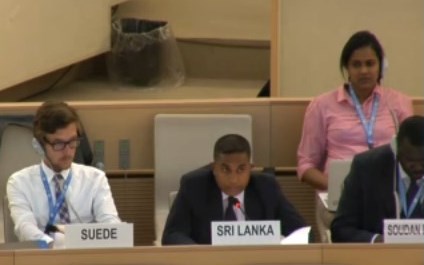
”In contrast to the considerable challenges in the humanitarian crises that continue to engulf many parts of the world today, Sri Lanka’s achievements particularly following the ending of the terrorist conflict provides confidence and hope that even the most severe and insurmountable humanitarian crisis can be overcome, with political commitment.”
Ambassador Ravinatha Aryasinha made this observation during the Interactive Dialogue with the Special Rapporteur on the Human Rights of Internally Displaced Persons in the Human Rights Council on Thursday, 12 June. The Special Rapporteur presented his report to the 26th session of the Council, currently underway in Geneva, pursuant to his mission to Sri Lanka in December 2013 at the invitation of the Government. He undertook several field visits during his mission, where he was provided with unfettered access, to engage with a variety of actors, including civil society.
Intervening in the interactive dialogue with the Special Rapporteur on Violence against Women and SR on Extreme Poverty at the 26th UN Human Rights Council in Geneva on 12th June 2014, Sri Lanka said “We believe that in national policy formulation to combat violence against women, it is necessary to focus on gender equality and the empowerment of women to enable them to fully enjoy their human rights and fundamental freedoms. Sri Lanka’s national policy framework, has consistently highlighted the importance of gender equality and taken measures to alleviate any existing gender gaps”.
- Sri Lanka says States should take steps to implement health education programmes to promote healthy food options in schools
- Sri Lanka says will not cooperate with the OHCHR-driven "comprehensive investig ation"
- Sri Lanka acutely conscious of extremist elements and terrorist groups seeking to foster separatist agenda and engender hatred, discrimination and intolerance