
Mr. President,
Excellencies,
Distinguished Delegates,
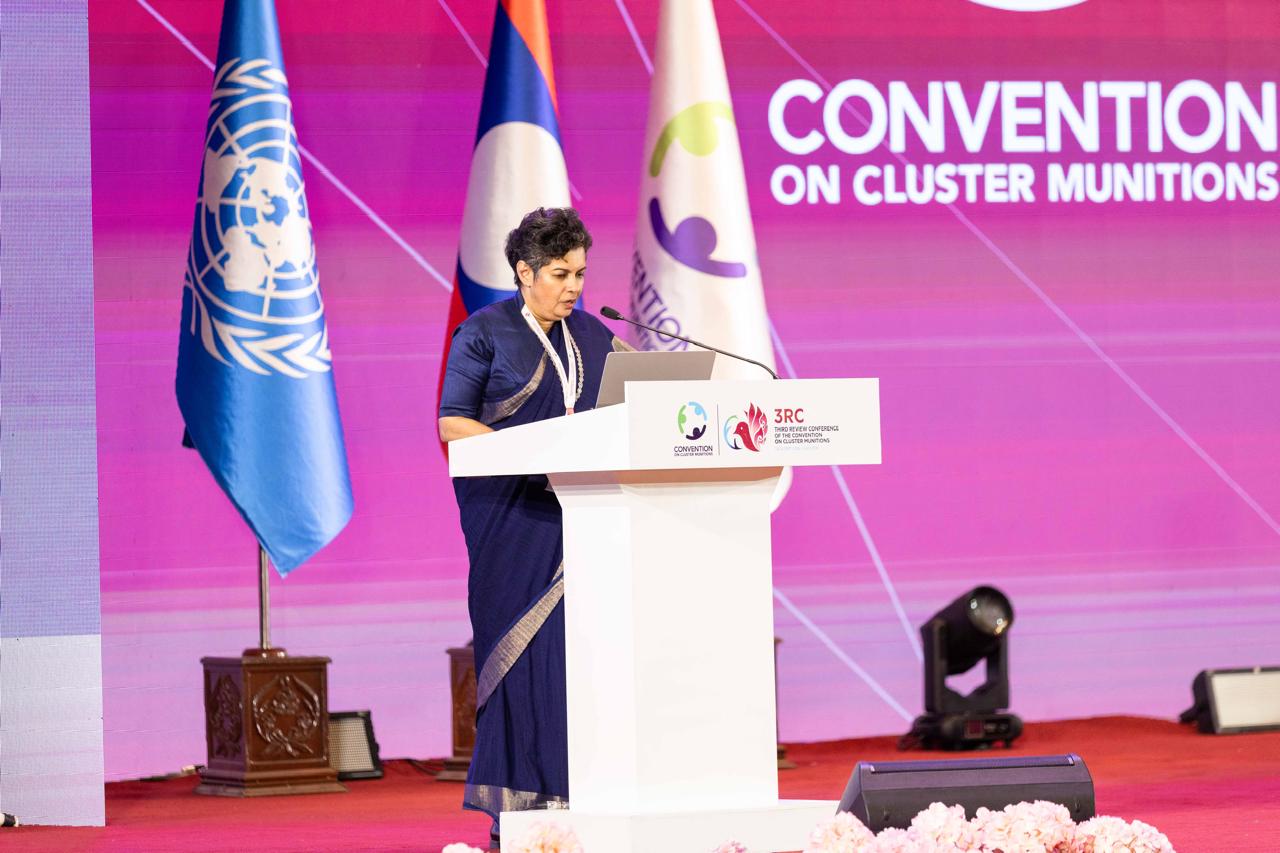
I wish to at the outset congratulate His Excellency Thongsavan PHOMVIHANE, the Deputy Prime Minister and Minister of Foreign Affairs of the Lao People’s Democratic Republic, on his assumption of the Presidency of the Third Review Conference of the Convention on Cluster Munitions (CCM). We also thank the Government of Lao PDR for their commitment, excellent Conference arrangements as host, and warm hospitality. Sri Lanka assures you Mr. President, of our fullest cooperation and support, as we deliberate on our collective commitment to advance the overarching humanitarian objectives of this critical Convention.
Sri Lanka welcomes the three States Parties Nigeria (ratification, 2023), South Sudan (accession, 2023), and Vanuatu (accession, 2025), that joined the Convention since the Second Review Conference, reflecting their commitment to the objectives of humanitarian disarmament.
Mr. President,
Sri Lanka’s historic accession to the Convention in 2018 has demonstrated our abiding commitment to International Humanitarian Law (IHL) and global disarmament. Sri Lanka’s dedication was further demonstrated through our active leadership in the Convention by assuming the Presidency of the Ninth Meeting of States Parties (9MSP) in 2019, soon after our accession to the Convention, and by our active contribution to the Bureau as Vice President in the four consecutive years. In these proactive roles, Sri Lanka consistently championed universalization and fostering of multilateral dialogue to the global implementation and promotion of the Convention.
Sri Lanka considers the Convention on Cluster Munitions to be a historic milestone in IHL and global disarmament, given its holistic and comprehensive approach in addressing the human suffering caused by these weapons. Our participation today underscores our steadfast commitment to eliminating the threat posed by cluster munitions worldwide.
Mr. President,
The Convention's legally binding prohibitions on the use, stockpiling, production, and transfer of cluster munitions are essential to upholding international law. Additionally, cluster munitions remain a persistent postconflict hazard. As we saw during the field visit to Luang Prabang, unexploded submunitions contaminate the land for decades and generations to come; threatening civilian infrastructure and endangering populations, long after hostilities end.
In this regard, it is vital to advance victim assistance, accelerate stockpile destruction, clearance and destruction of cluster munition remnants in affected areas, promote risk reduction education, especially among youth, and enhance international cooperation and assistance.
We believe that integrating cluster munition victims into broader national disability, health, and social welfare frameworks, through a survivor-centric approach and inclusive socio-economic reintegration would be important with regard to the affected States.
Mr. President,
We are meeting at a crucial juncture in the complex global security landscape. Recent conflicts worldwide have witnessed an increased risk in the use, production, and transfer of cluster munitions. The continued deployment of these indiscriminate weapons pose severe threats to civilian populations, exacerbates humanitarian crises, and undermines decades of progress achieved in multilateral arms control and humanitarian disarmament.
Sri Lanka unequivocally condemns any use of cluster munitions by any actor under any circumstances. The erosion of international norms must not be allowed to undermine the humanitarian gains achieved through this Convention. Therefore, we call upon all States, particularly those possessing large stockpiles, to cease the production and transfer of these weapons and commit to their total elimination.
Mr. President,
This Third Review Conference serves as an indispensable opportunity to review our achievements, confront emerging challenges, and set a practical way forward for the next five years. Sri Lanka, as a country that has successfully overcome the challenges of a conflict, welcomes the core Outcome Documents before us, which provide an important framework for guiding our collective efforts over the next five years:
- Sri Lanka views the Vientiane Capital Action Plan (VCAP) 2027–2031 as a forward-looking roadmap that would build constructively upon the Lausanne Action Plan. We particularly welcome its increased emphasis on integrating environmental impact and climate risk assessment across clearance, survey, and stockpile destruction activities, as well as its strong alignment with the Sustainable Development Goals (SDGs), the Convention on the Rights of Persons with Disabilities (CRPD), and the UN Agendas on Women, Peace, and Security (WPS) and Youth, Peace, and Security (YPS).
- While supporting quantitative targets in the Action Plan, we reemphasize the importance of practical and standardized methodologies for measuring progress. Affected States with limited administrative capacity must be supported through simplified reporting pathways and enhanced international technical cooperation.
- We also welcome the focus of the Outcome Documents on compliance maintenance, managing newly discovered stockpiles, and intensifying efforts towards universalization.
Mr. President,
Sri Lanka remains firmly committed to working alongside the Presidency, States Parties, international organizations, and civil society organizations to ensure the robust implementation of the Outcome Documents that would be adopted at this landmark Conference.
Let us remain steadfast in our collective efforts to end the suffering caused by cluster munitions, and build a safer, more secure world for future generations.
I thank you Mr. President