

Ministry of Environment organized side event on 'Hepatoprotective activity of Mercury containing Lokanatharasa with special reference to Hepatocellular carcinoma' was held during the Fifth meeting of the Conference of the Parties to the Minamata Convention on Mercury (COP-5) on 2 Nov 2023 in Geneva. Prof. Sujeewa Harapathdeniya of Institute of Indigenous Medicine joining virtually made a presentation based on research conducted in SriLanka with United Nations Industrial Development Organization (UNIDO) and Swiss government assistance.

President Ranil Wickremesinghe addressing the COP 27 Climate Change Conference in Sharm El-Sheikh, Egypt said that unbridled industrialization of the developed countries is the root cause of climate change, leaving the poor to suffer the consequences. He said that the problems facing poor countries are augmented due to the absence of adequate funding.
As a result, these countries are facing double jeopardy – struggling to develop economically while fighting to protect the living standards of their populations.
Therefore, President Wickremesinghe said that the developed countries must deliver on their pledge in Glasgow – by doubling their funding to compensate the developing countries for loss and damage.
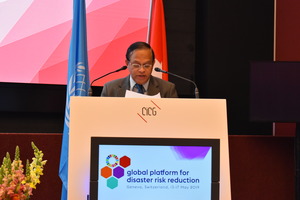
Risk-sensitive economic planning and coherence between climate and disaster risk reduction (DRR) policies are vital in building resilient societies and economies as envisioned by the Sustainable Development Goals (SDG), Sri Lanka’s Permanent Representative to the UN in Geneva, Ambassador A.L.A. Azeez stated. He made these remarks addressing the Sixth Global Platform on Disaster Risk Reduction held in Geneva from 13 to 17 May 2019.
Sri Lanka is taking a number of initiatives towards this end, he added, highlighting national measures to establish an online damage and loss assessment system for all sectors in line with international standards, a Climate-Resilient Integrated Water Management Project aimed at strengthening the resilience of vulnerable smallholder farmers in the dry zone, and a Climate Resilience Improvement Project focused on building a more climate-resilient economy.
“In Sri Lanka, national strategies for disaster risk reduction have been formulated for the period of 2019-2030 and the National Policy on Disaster Risk Management has been updated to enable risk-informed implementation and monitoring of the 2030 Sustainable Development Agenda, the UN Urban Agenda and the Paris Agreement on Climate Change.”
“Among specific measures taken or being taken are the introduction of an insurance scheme against natural disasters for all houses and Small and Medium Scale Enterprises (SMEs), National Building Codes for disaster-resilient construction, guidelines to mainstream disaster risk reduction, and mainstreaming DRR into the education sector,” he stated.
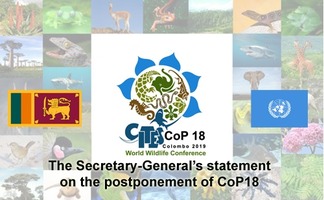
The Secretariat regrets to announce that the 18th meeting of the Conference of the Parties (CoP18), originally scheduled to take place from 23 May to 3 June in Colombo, Sri Lanka, as well as the associated 71st and 72nd meetings of the Standing Committee, are being postponed. This decision has been taken out of respect for the victims of the recent attacks and the recognition by the Standing Committee, the Secretariat and the United Nations Department of Safety and Security of the time needed for the Government of Sri Lanka to address the current situation in the country.
We are fully committed to ensuring the safety and well-being of all delegates. The Secretariat is monitoring the situation closely in consultation with the Sri Lankan authorities and the United Nations Department of Safety and Security. The Conference of the Parties has chosen Sri Lanka as next host Party and we are deeply grateful for the efforts Sri Lanka has made thus far as host. The Secretariat will be working with Sri Lanka to try and honour this choice in consultation with the UN Department of Safety and Security and the CITES Standing Committee.
Our support and solidarity remain with the people of Sri Lanka and all of those who have suffered losses from these tragic events.
We will make further information about CoP18 available as soon as possible. Meanwhile, the Secretariat continues to work on advancing the many substantive issues as mandated by the Conference of the Parties.
Thank you for your patience and understanding.
Ivonne Higuero
Secretary-General
26 April 2019

“A study of the health effects of marine plastic pollution and micro-plastics is important for strengthening national and global initiatives to combat plastic pollution of our oceans”, stressed Ambassador A.L.A. Azeez, Sri Lanka’s Permanent Representative in Geneva, addressing an interactive Panel Discussion held at the Graduate Institute of Geneva as part of the Geneva Sustainability Week.
At the interactive Panel Discussion ‘Our Plastic Future: Can the Oceans Survive?’ where a number of participants actively engaged, Ambassador Azeez elaborated Sri Lanka’s efforts and commitment towards achieving effective and non-discriminatory global environmental governance, highlighting further the measures taken by Sri Lanka in this context, including at the recently concluded Fourth Session of the United Nations Environment Assembly in Nairobi.
“Sri Lanka’s strategic path for sustainability 2030 has, as its central focus, environmentally sound development activities, complemented by international assistance including technical assistance and sharing of know-how”, he added.
Ambassador Azeez also highlighted the constructive role and contribution that Sri Lanka has made, over decades, to matters of multilateral concern impacting the nature and the environment, referring specifically to the leadership given by Sri Lanka in areas such as the Law of the Sea and innovative initiatives taken in relation to biodiversity, transboundary movement of hazardous waste and trade in endangered species.

Addressing the 2019 World Wildlife Day celebration in Geneva held under the theme ‘Life Below Water: For People and Planet’, Ambassador Azeez said that, in this context, Sri Lanka was proud and honoured to be the host of the 18th Meeting of the Conference of Parties to the Convention on International Trade in Endangered Species of Wild Fauna and Flora (CITES), in Colombo, from 23 May to 3 June this year.
“We are pleased to note that the Conference has received a record number of working documents and species-listing proposals, making it the largest Conference of Parties in the history of CITES to date. Interestingly, it is the mako shark, wedgefish, and guitarfish proposals submitted for the CoP18 that have received major support from Parties to the CITES. .Sri Lanka is proud to cosponsor all 3 of these proposals at the upcoming Conference, which will also be conducted in a carbon-sensitive manner”, he said.
Sri Lanka is readying itself for the hosting of COP 18 of CITES in Colombo 2019. Known as World Wildlife Conference, the 18th Meeting of the Conference of Parties (COP18) to the Convention on International Trade in Endangered Species of Wild Fauna and Flora, attracts 183 parties (182 States + European Union) with the participation of up to 4500 to 5000 delegates & stakeholders.
In continuing demonstration of its consistent national commitment to the protection of the Environment and wild fauna and flora, as well as advancing progress in the Sustainable Development Goals to 2030, Sri Lanka is proud to host this major global conference in the Colombo, from 23 May – 3 June 2019.
The Ministry of Tourism Development, Wildlife and Christian Religious Affairs, along with Presidential Secretariat, Ministry of Foreign Affairs & the Permanent Mission of Sri Lanka in Geneva, has been making Conference related arrangements as well as substantive preparations for the CITES COP 18, fully assisted by the CITES Secretariat in Geneva.
Permanent Mission of Sri Lanka
Geneva
14th February 2019
- Sri Lanka announces dates for the 18th Meeting of Conference of Parties to the CITES to be held in the Colombo in 2019
- Sri Lanka to strengthen collaboration with the World Meteorological Organization
- Minister Premajayantha calls for cross–border cooperation to finance e –waste management in the developing countries