
The Secretariat regrets to announce that the 18th meeting of the Conference of the Parties (CoP18), originally scheduled to take place from 23 May to 3 June in Colombo, Sri Lanka, as well as the associated 71st and 72nd meetings of the Standing Committee, are being postponed. This decision has been taken out of respect for the victims of the recent attacks and the recognition by the Standing Committee, the Secretariat and the United Nations Department of Safety and Security of the time needed for the Government of Sri Lanka to address the current situation in the country.
We are fully committed to ensuring the safety and well-being of all delegates. The Secretariat is monitoring the situation closely in consultation with the Sri Lankan authorities and the United Nations Department of Safety and Security. The Conference of the Parties has chosen Sri Lanka as next host Party and we are deeply grateful for the efforts Sri Lanka has made thus far as host. The Secretariat will be working with Sri Lanka to try and honour this choice in consultation with the UN Department of Safety and Security and the CITES Standing Committee.
Our support and solidarity remain with the people of Sri Lanka and all of those who have suffered losses from these tragic events.
We will make further information about CoP18 available as soon as possible. Meanwhile, the Secretariat continues to work on advancing the many substantive issues as mandated by the Conference of the Parties.
Thank you for your patience and understanding.
Ivonne Higuero
Secretary-General
26 April 2019

Signing the condolence book at Sri Lanka Mission in Geneva today, Secretary General of Inter-Parliamentary Union H.E. Martin Chungong expressed his deep condolences to the families of victims and people of Sri Lanka on the devastating Easter Sunday tragedy.
Permanent Mission of Sri Lanka
Geneva
25 April 2019
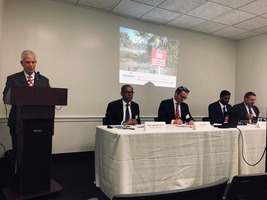
The Congressional (UXO)/ Demining Caucus held a panel discussion on demining efforts in Sri Lanka on 14th March at the Capitol Hill where the government’s ownership of the program and the commitment for a mine free Sri Lanka came for praise by the implementing partners and the US government. The Panel Discussion was held on the invitation of the Co-chairs of the UXO/ Demining Caucus, Representative Bill Johnson (R) and Representative (D) Jackie Spiers.
Rear Admiral Dharmendra Wettewa, Minister (Defence) represented the Embassy at the panel which also included Mr. Alistair Moir, of the Mine Advisory Group (MAG), Mr. Vithoozan Anthony of the HALO Trust and Mr. Rodney A Robideau, the Conventional Weapon Destruction Program Manager, South and Central Asia of the Department of State.
Introducing the speakers of the panel, Co-Chair Rep. Bill Johnson spoke about the 30 years long ethnic conflict in Sri Lanka and touched upon the reconciliation and accountability process which he stated U.S.A. is following closely. He recalled his visits to Sri Lanka and expressed his great appreciation to the Sri Lankan government and the international partners, especially the dedication of the women Mine Clearance workers for their efforts to achieve the vision of a mine free Sri Lanka by 2020 and reiterated the U.S. government’s commitment to help achieving that goal.
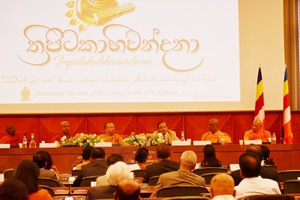
An interactive scholarly discussion on the significance of the Tripitaka as a world heritage took place at the World Intellectual Property Office (WIPO) headquarters in Geneva, continuing the week-long celebrations-'Tripitakabivandana'. The event was also intended to raise awareness among States that follow the Buddhist traditions, as well as other States, to join hands with Sri Lanka in realising the initiative taken by President Maithripala Sirisena, to inscribe the Tripitaka on the UNESCO ‘Memory of the World’ Register.
Organized by the Permanent Mission of Sri Lanka in Geneva, the event brought together several erudite members of the Maha Sangha, members of the diplomatic community as well as Sri Lankans living in Geneva, to reflect on the spiritual, historical as well as global value of the Tripitaka-the foremost doctrine of Buddhist teaching. A strong call for the recognition of the Tripitaka as a shared heritage of mankind was echoed.
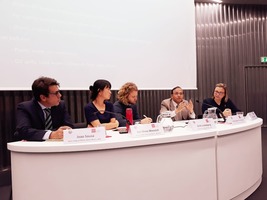
“A study of the health effects of marine plastic pollution and micro-plastics is important for strengthening national and global initiatives to combat plastic pollution of our oceans”, stressed Ambassador A.L.A. Azeez, Sri Lanka’s Permanent Representative in Geneva, addressing an interactive Panel Discussion held at the Graduate Institute of Geneva as part of the Geneva Sustainability Week.
At the interactive Panel Discussion ‘Our Plastic Future: Can the Oceans Survive?’ where a number of participants actively engaged, Ambassador Azeez elaborated Sri Lanka’s efforts and commitment towards achieving effective and non-discriminatory global environmental governance, highlighting further the measures taken by Sri Lanka in this context, including at the recently concluded Fourth Session of the United Nations Environment Assembly in Nairobi.
“Sri Lanka’s strategic path for sustainability 2030 has, as its central focus, environmentally sound development activities, complemented by international assistance including technical assistance and sharing of know-how”, he added.
Ambassador Azeez also highlighted the constructive role and contribution that Sri Lanka has made, over decades, to matters of multilateral concern impacting the nature and the environment, referring specifically to the leadership given by Sri Lanka in areas such as the Law of the Sea and innovative initiatives taken in relation to biodiversity, transboundary movement of hazardous waste and trade in endangered species.
Foreign Minister Hon. Tilak Marapana and delegation met with Madam Michelle Bachelet, UN High Commissioner for Human Rights and the Under- Secretary General in charge of the UN Office in Geneva Mr. Michael Moller this week, on the side-lines of the 40th Session of the Human Rights Council in Geneva.
High Commissioner Bachelet on 20 March, having received the delegation warmly, appreciated the progress made by Sri Lanka in some of the key human rights commitments arising from HRC resolution 30/1, and reaffirmed her readiness and willingness to continue to work with Sri Lanka closely in further strengthening implementation and achieving progress through technical assistance and support in areas where such assistance was required by Sri Lanka.
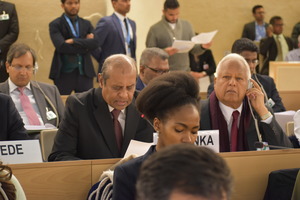
Minister of Foreign Affairs of Sri Lanka, Hon. Tilak Marapana, PC , addressed the 40th Session of the UN Human Rights Council today (21 March 2019) as the country concerned, during the adoption of the draft resolution A/HRC/40/L.1 “Promoting reconciliation, accountability and human rights in Sri Lanka”, at the Palais des Nations in Geneva.
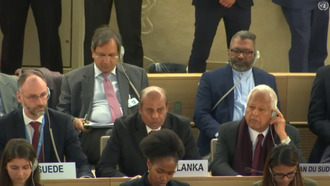
Hon. (Dr) Sarath Amunugama, Member of Parliament, the Governor of the Northern Province Hon (Dr) Suren Raghavan, Foreign Secretary Ravinatha Aryasinha, Deputy Solicitor General Nerin Pulle, Permanent Representative Ambassador A.L.A. Azeez, Deputy Permanent Representative Mrs. Samantha Jayasuriya and the diplomatic officers of the Permanent Mission of Sri Lanka to the UN in Geneva were associated with the Foreign Minister.
Permanent Mission of Sri Lanka
Geneva
21st March 2019
- Minister of Foreign Affairs of Sri Lanka, Tilak Marapana, addresses the 40th session of the UN Human Rights Council (UNHRC)
- Sports - an important means of empowering people and bridging divides within societies – Ambassador Azeez tells the Human Rights Council
- “The environment is an enduring aspect of Sri Lanka’s national development”