
Opening remarks by Chairperson H.E. Mme Sarala Fernando at the hundred and Third Session of the Executive Committee of IOM, 7th June, 2006
Excellencies,
Mr. Director-General
distinguished delegates
I would like to thank you for my election to Chair this session of the Executive Committee. I take it as an honour to my country which has recently joined the Executive Committee for the first time. I also congratulate the Vice President Mr. Osvald Alvarez of Chile on his election.
Decent Work as a Global Goal: The Role of Development Cooperation
Chairperson,
On behalf of the government and the delegation of Sri Lanka, it is a great honour for me to address this panel on Technical Cooperation with a specific focus on Decent Work as a Global Goal: The Role of Development Cooperation.
Chairperson,
I understand that Sri Lanka is one of the first countries in Asia, where we have taken the Decent Work concept into our national development planning. In addition to the Decent Work Country Programme, which we finalized in 2004 together with the trade unions and the employers’ organisation, I am very pleased to inform you that we have now finalised the National Policy on decent work with a National Plan of action that gives directions on key areas for implementation in Sri Lanka.
Mr. President, Your Excellencies and distinguished delegates.
Mr President,
I extend our congratulations and best wishes to you and the Vice-Presidents of this Assembly.
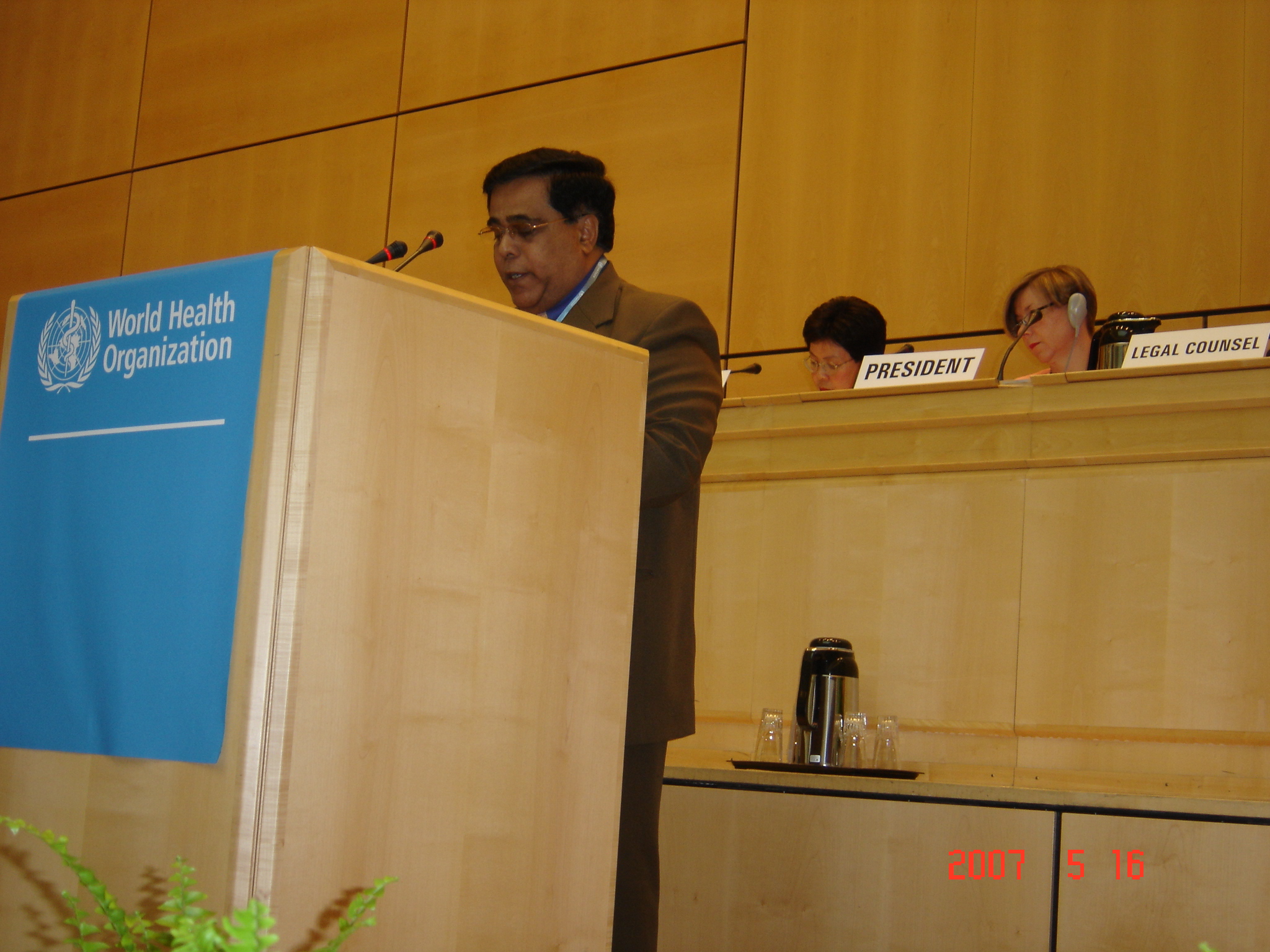
On behalf of H.E. the President Mahinda Rajapaksa, the Government and people of Sri Lanka, I wish to extend our deepest condolences on the sudden passing away of Director General Dr. Lee Jong-wook. We extend our sincere condolences to the family of Dr. Lee and to the larger family of WHO in their moment of grief for a leader who brought effective management and a new vision to this organization. Sri Lanka will not forget Dr. Lee’s visit to Sri Lanka in the midst of our tsunami crisis to offer the support of WHO in our time of need.
Mr. Chairman,
I am pleased to deliver this statement on behalf of the Asian Group.
At the outset we would like to thank Dr. Supachai Panitchpakdi, Secretary General of UNCTAD for his comprehensive and focussed statement. We would also like to thank the Secretariat for the stocktaking report which shows important progress has been made in the implementation of the Sao Paulo Consensus (SPC), while noting also areas for improvement. We expect UNCTAD to fully implement over the next two years, the mandate given to it by its Member States at Sao Paulo. A renewal or a complete review of UNCTAD’s mandate can only be undertaken by the quadrennial conferences.
- The national CODEX Committee of Sri Lanka submitted its comments and arguments on the use food additive Sulpher Dioxide (SO2) in Food Category 12.2.1, as contained in document CX/FAC/06/38/9 part 1.
- Since November 2004, Sri Lanka has encountered problems with a number of consignments of “ Ceylon Cinnamon “ exported to the European Union on the grounds that the consignments contained Sulphur Dioxide ( SO2).
- Sulphur Dioxide (SO2) is a known, accepted & a widely used food additive & is described as ‘ one of the most important & versatile additives with a good safety record ‘ used in the food industry.
Excellencies, Ladies and Gentlemen,
It gives me great pleasure, in my capacity as Chair of the 2005 session of the Joint Advisory Group meeting, to open this thirty ninth session. I welcome Mr. Pascal Lamy, the Director General of WTO and Dr. Supatchai Panitchpakdi the Secretary General of UNCTAD. Equally I recognize Mr. Denis Bélisle Executive Director of ITC, his successor-designate Mrs Patricia Francis and Mr Stephen Browne, the recently appointed Deputy Executive Director. UNCTAD, WTO and ITC must be congratulated for the smooth execution of the plan for the succession of ITC’s senior management team.
The successful conclusion of the Negotiations under the Doha Development Agenda would result in significant gains to both developed and developing countries. However, as in the case of the Uruguay Round, these gains will not be evenly distributed. The trade liberalization would also entail additional costs, to some developing countries. The impact of these will be particularly harsh on the LDCs and the weak and vulnerable economies. Furthermore, some developing countries also will not benefit from the multilateral trade liberalization as they do not have the capacity to compete in the global markets with more competitive exporters from developed and more advanced export-oriented developing countries.
- Statement made by H.E. Mrs. Sarala Fernando, Ambassador, Permanent Representative of Sri Lanka, coordinator of the Asian Group and China at the UNCTAD Commission on Investment, Technology, and Related Financial Issues 10th Session Geneva 6 – 10 March, 200
- Statement of Sri Lanka delegation at the Conference of Parties to the WHO Framework Convention on Tobacco Control, delivered by Dr.Lakshmi Somatunga-7 February 2006
- Statement of Sri Lanka delegation at the 94th (Maritime) session of the International Labour Conference delivered by Mr A R M Abeyratne Banda- 20 February 2006