Distinguished Delegates, Ladies and Gentlemen, To begin with, I feel so honoured and privileged to be in this wonderful capital and largest city of Switzerland on behalf of my delegation. It is a great pleasure for me to address the 148th IPU Assembly...
Sri Lanka is deeply troubled about the death of over hundred people who were waiting to receive aid in Gaza and joins the call for investigation into the incident. The latest incident underscores the immediate need to end the blockade imposed on Gaza,...
Attending the 54th Annual Meeting of the World Economic Forum (WEF) 2024 in Davos, Switzerland at the invitation of its Founder and Chairman Prof. Klaus Schwab, President Ranil Wickremesinghe interacted with world...
Eleventh Meeting of States Parties to the Convention on Cluster Munitions 11 – 14 September 2023 Statement by Sri Lanka Agenda Item 8: General Exchange of Views Thank you Mr. President, Sri Lanka joins...
General Intervention by H.E. Himalee Arunatilaka, Ambassador and Permanent Representative of Sri Lanka to the UN in Geneva, on 28 August 2023 Mr. Chair, Sri Lanka compliments the work accomplished...
Intervention by Dr. Samiddhi Samarakoon, National Coordinator, Disaster Preparedness and Response Division of the Ministry of Health on National Inventory of Dangerous Pathogens (NIDP) Thank you...
Intervention by Dr. Samiddhi Samarakoon, National Coordinator, Disaster Preparedness and Response Division of the Ministry of Health on the Implementation of Biological Weapons Convention Plan in...

NOTICE
Launching website of the new visa system from 16 April 2024.
The previous online visa website (Electronic Travel Authorization-ETA) has expired since 16 April 2024.
Please use the following link to apply for ETA from 17 April 2024 onwards.


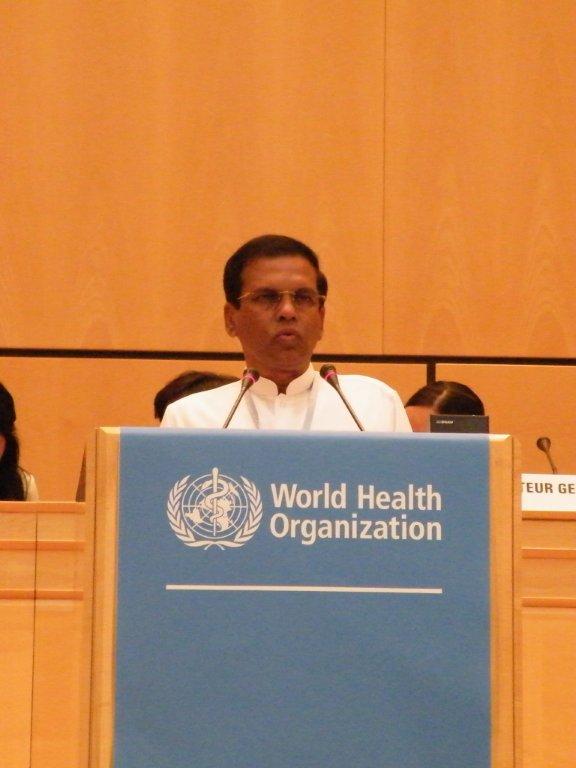
Hon Minister Maithripala Sirisena addressesthe 65th World Health Assembly in Geneva
The Sri Lankan delegation headed by the Hon Minister Maithripala Sirisena participated at the 65th World Health Assembly which concluded in Geneva last week. The assembly which took place at the United Nations Headquarters in Geneva was attended by more than 190 Member States, UN bodies and Civil society representatives. Addressing the assembly on the second day, the hon. Minister outlined the achievements and developments taking place within the medical and health spheres in Sri Lanka and further elaborated on Sri Lanka’s future plans.
The Hon Minister also met with the health Ministers of Bangladesh and Maldives during the sidelines of the World Health Assembly and discussions centered around future collaborations and bilateral capacity building projects.
Within the International community Sri Lanka has been highly commended on its innovative approach to migration health services and policy development, with Minister Sirisena taking the forefront on discussions with the International Organisation for Migration. During the 64th World Health Assembly, the Hon Minister presented Sri Lanka’s progress report on the Assembly’s ‘Health of Migrants’ resolution, the first WHO Member state to take such an initiative.
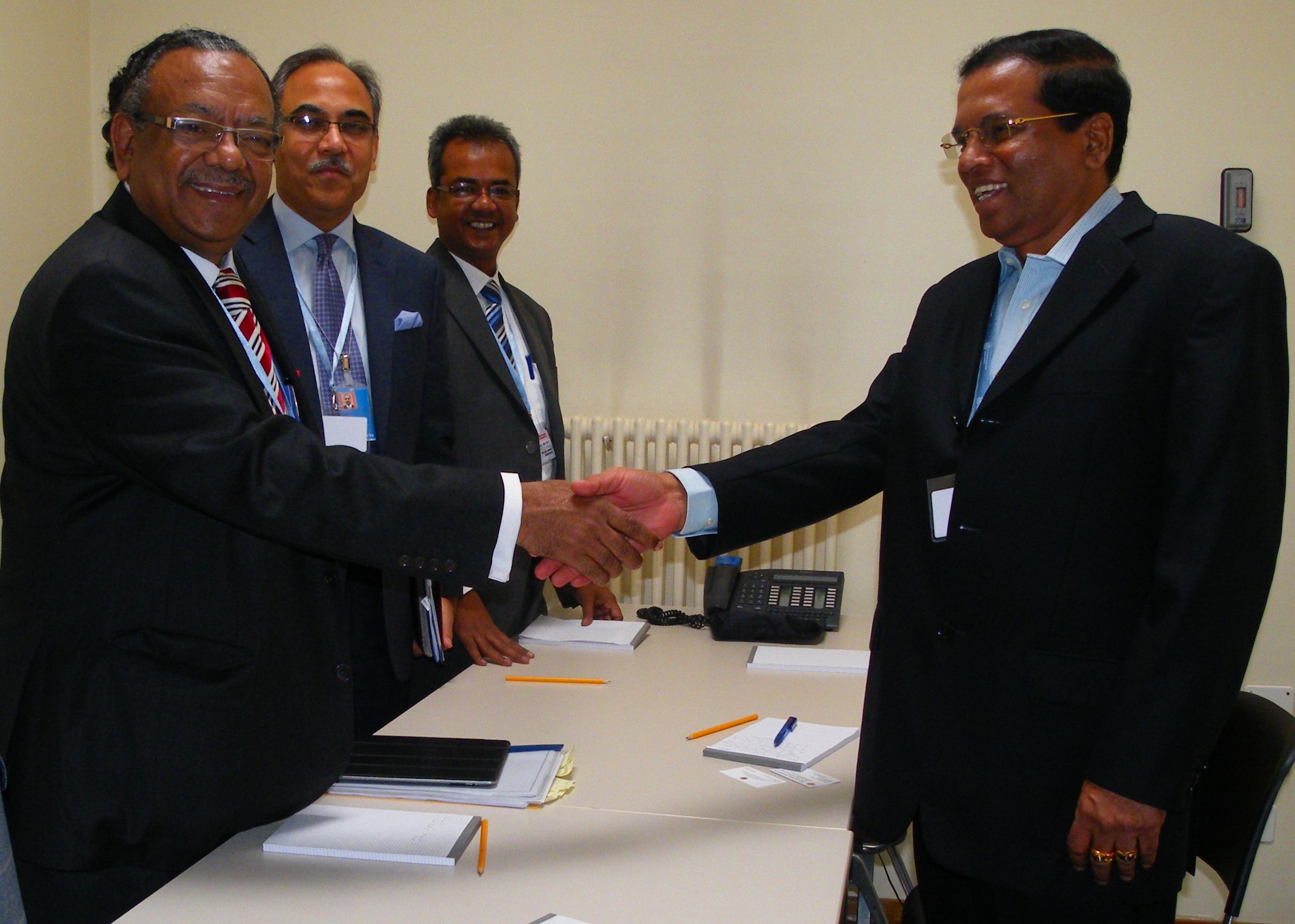
Bilateral meeting withBangladesh Minister of Health & Family Welfare, Prof. Ruhal Haque
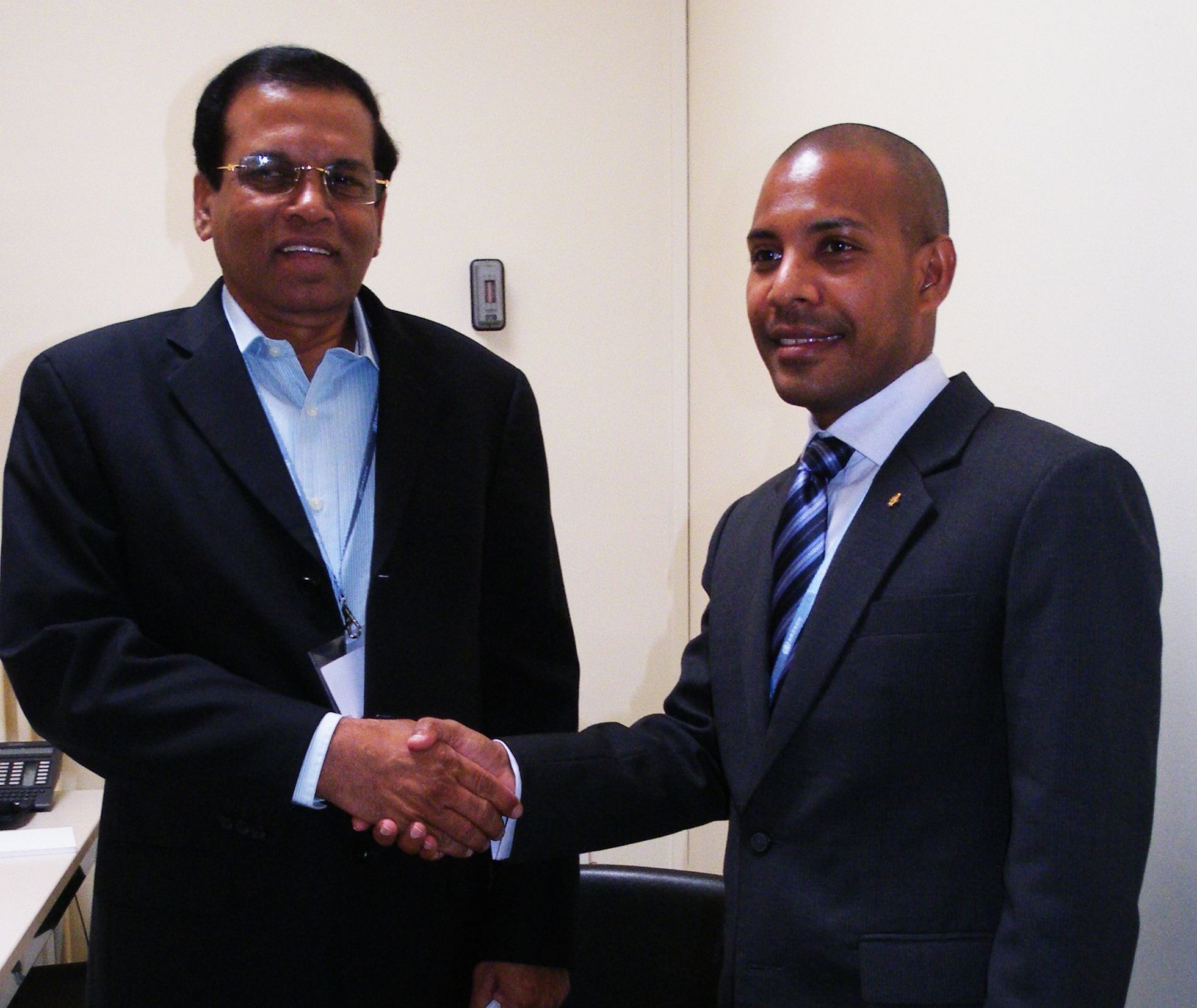
Meeting with Dr. Ahmed Jamsheed Mohammed Minister of Health, Maldives
Read Full text of the Hon Minister’s address at the 65th World Health Assembly:
Madam President,
Excellencies,
Ladies and Gentleman,
As the Minister of Health of the Democratic Socialist Republic of Sri Lanka I thank you for this opportunity to address the 65th World Health Assembly, and I consider this as an honor and a privilege, for me and my country.
I warmly congratulate you madam President, on your election to this prestigious position of this forum. I also congatulate Dr.Margret Chan the energetic Director General of World Health Organization for her outstanding leadership.
Our topic today is 'towards universal coverage'.It is timely that we put our knowledge and resources, together with the World Health Organization, to strive to attain this goal of universal coverage within our lifetime.
Madam President, over the years, we in Sri Lanka managed to control and eliminate many diseases.For example Polio cases have not been recorded since 1993. Neo-natal tetanus, diphtheria, measles, and rubella cases are not reported at all, or at a very low level.
Further, Malaria, Filaria, Leprosy, Rabies and many other deadly diseases were brought down to a near elimination level.
We have given due importance to the control of non-communicable diseases (NCDs) by initiating various mega-programmes on a national scale. We are very much concerned about the fitness and health of our people. Accordingly we have introduced several services and programmes to meet the emerging nutrient needs of our people both young and elderly.
Maternal health, Child health and Family planning are closely integrated and we provide various services through a well developed infrastructure of the Ministry of Health, with a wide network of medical institutions and health units.
Sri Lanka is continuing rapidly to advance the World Health Assembly resolution on Health of the migrants, to create migrant friendly health policies and practices, and we are the first country in the world to report progress on the WHA Resolution.
Ladies and gentlemen, before I conclude I wish to express my sincere appreciation and gratitude for the cooperation and help extended by WHO to upgrade and enhance the health care facilities in Sri Lanka.
Finally I thank the World Health Assembly for the hospitality accorded to our delegation in Geneva I am sure the decisions arrived at this Assembly will have great significance for people everywhere to achieve better health which is the greatest gift for mankind.
Thank you.
 Important Links


