Distinguished Delegates, Ladies and Gentlemen, To begin with, I feel so honoured and privileged to be in this wonderful capital and largest city of Switzerland on behalf of my delegation. It is a great pleasure for me to address the 148th IPU Assembly...
Sri Lanka is deeply troubled about the death of over hundred people who were waiting to receive aid in Gaza and joins the call for investigation into the incident. The latest incident underscores the immediate need to end the blockade imposed on Gaza,...
Attending the 54th Annual Meeting of the World Economic Forum (WEF) 2024 in Davos, Switzerland at the invitation of its Founder and Chairman Prof. Klaus Schwab, President Ranil Wickremesinghe interacted with world...
Eleventh Meeting of States Parties to the Convention on Cluster Munitions 11 – 14 September 2023 Statement by Sri Lanka Agenda Item 8: General Exchange of Views Thank you Mr. President, Sri Lanka joins...
General Intervention by H.E. Himalee Arunatilaka, Ambassador and Permanent Representative of Sri Lanka to the UN in Geneva, on 28 August 2023 Mr. Chair, Sri Lanka compliments the work accomplished...
Intervention by Dr. Samiddhi Samarakoon, National Coordinator, Disaster Preparedness and Response Division of the Ministry of Health on National Inventory of Dangerous Pathogens (NIDP) Thank you...
Intervention by Dr. Samiddhi Samarakoon, National Coordinator, Disaster Preparedness and Response Division of the Ministry of Health on the Implementation of Biological Weapons Convention Plan in...

NOTICE
Launching website of the new visa system from 16 April 2024.
The previous online visa website (Electronic Travel Authorization-ETA) has expired since 16 April 2024.
Please use the following link to apply for ETA from 17 April 2024 onwards.


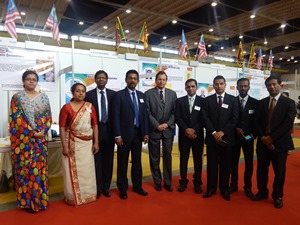
A team of 7 inventors led by Dr. Mahesh Edirisinghe, Commissioner of Sri Lanka Inventors Commission (SLIC) participated at the recently concluded 44th International Inventors Exhibition held from 13-17 April 2016 in Geneva. They have secured 2 Gold Medals with a special recognition from jury for one invention, 3 Silver Medals and 2 Bronze Medals.
Two inventors were fully sponsored by Sri Lanka Inventors Commission (SLIC), having been selected from among the Presidential Award Winners and Sahasak Nimavum Award winners while the other inventors have joined the Sri Lankan delegation on their own expenses.
The International Inventors Exhibition is known as the world’s largest market-place for inventions. At this unique annual event, there were more than 1’000 new inventions and products, 752 exhibitors from 48 countries, 76% companies and universities, 24% private inventors and researchers, 59’000 visitors from all 5 continents. An International Jury of 85 experts awarded many highly regarded prizes to the best inventions.
The following Sri Lankan inventors won awards at the International Inventors Exhibition held in 2016:
| Inventors Name | Name of the Invention | |
| Mr. N.C. Lokuhettige | Automatic Artificial Leg | Gold Medal |
| Mr. R.M.S.B. Hunukumbura | Mechanical Eakle Separator | Gold Medal |
| Prof. K.K.Y.W. Perera | Smart Ceiling Fan Controller | Silver Medal |
| Mr. K.K.N.P. Kannangara (Co-invention) |
Inhalation Capsule with new dry |
Silver Medal |
| Mr. Manoj S. Hettiarachchi (Co-partner) | - do - | |
| Ms. K.D.S. Anusha Wijayarathna | Special Corn Flour Mixture | Silver Medal |
| Dr. S.M.R. Bandara | Device especially for suppression of Neuropsychiatry & Respiratory Diseases |
Bronze Medal |
| Ms. D.G.A.I. Jayarathna | Device with Catheter Tube and External Public Bladder with Hanger |
Bronze Medal |
Permanent Mission of Sri Lanka
Geneva
18 April 2016
 Important Links


